ASTRO is a Motorola Radio Communication System for LMR (Land mobile radios). It’s created for digital two-way radio communication.
Site is a physical device with a big antenna. It has various hardware devices stacked on each other that allows to manage the radio channels, frequencies, and other critical functions functions.
Role & Responsibilities:
As an independent researcher, I conducted an end-to-end research, present findings & educate internal stakeholders about customer's mindset.
Timeline:
May’24 - Dec’25 | 16 months
Project Type:
Critical Communication System for Public Safety | Industrial project
To ensure the ASTRO system running 24/7, risk-free, and operational even during severe weather, which is critical for public safety, it requires full upgrade every two years and security patching every three months.
Maintaining the uptime of the ASTRO system is critical for public safety operations. System upgrades and patching are performed after the entire system has been deployed at the customer's location. Following deployment, these services are included as part of the service agreement for customers who choose to opt in.
Motorola Solutions (MSI) spends approximately $800 million annually on these services and support for clients with service agreements. The existing service team structure and operating costs were deemed excessively high than expectation/budget.
Along with it, it was reported that the system deployments at new customers are getting delayed by 2x times due to operational inefficiencies..
The business team wanted to improve profitability and operational efficiency within the services division by reducing upfront operational expenses.
The business team targeted profitability by to cutting the service-related costs by 30%, reducing upgrade related delivery delays at least by 70%.
R1: The service organisation is broad, consisting of various interlinked smaller teams. Research aims to understand the jobs carried out by each team, their roles and responsibilities from deployment till delivery.
R2: Identify redundant task flows and opportunities for potential saving and automation .

- Messy and Unconnected Tools: The team built tools one by one whenever a need popped up, so the tools didn't work well together. Because of this, some engineers liked using them, but others completely ignored them.
- No Training or Fixes: No one took responsibility for updating the tools or fixing problems. There was also no training for the engineers, so the tools stayed the same and never got better.
- This user group are afraid of going to banks and talking to banking associates or managers. They feel they might not understand the banking language associates will use to perform any banking transactions.
- Too Hard to Learn: The process was slow and confusing for new people. It took engineers ~ 18 months just to learn how to use the tools, mostly by watching others work (shadowing).
- Investigation Plan: To fix these problems, we decided to study how the tools are currently used. We want to figure out exactly why people aren't using them, what they like, and what they don't like.
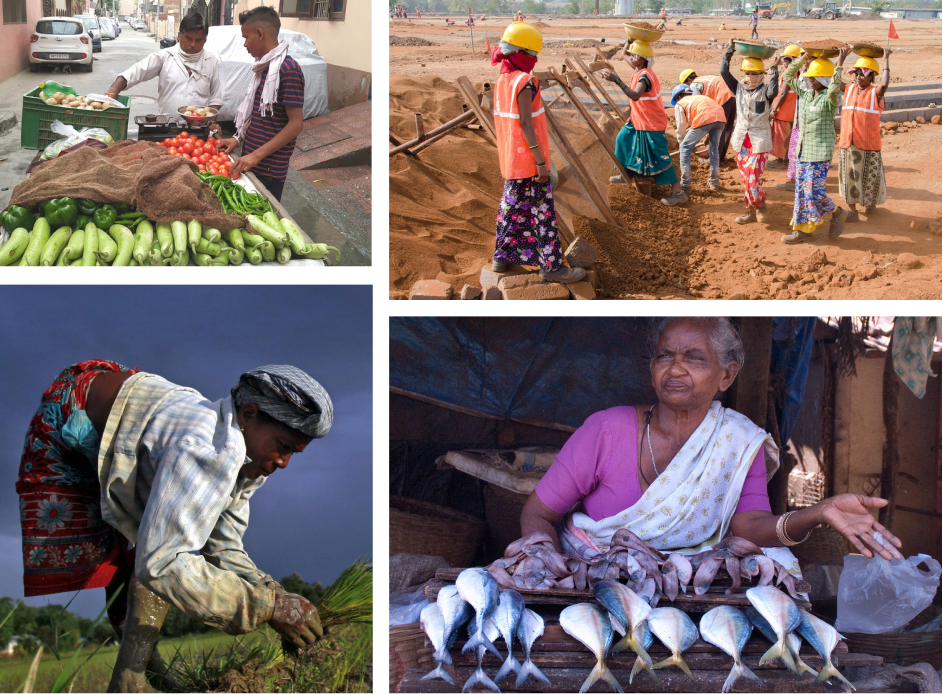
To better understand retailer's beliefs, challenges and goals, I decided observe 14 expert retailers from Mumbai city.
Observing users in their own environment assisted to draw conclusions about their behaviour in society.
Methodology
Why -
To understand how retailer work in their contextual settings and to understand their goals, beliefs and daily jobs
Whom -
14 expert retailers whose monthly earnings is greater than $4000 (~INR 3,00,000)
What -
Qualitative Research - Ethnographic studies
Where -
In field - Local stores from Mumbai city of India
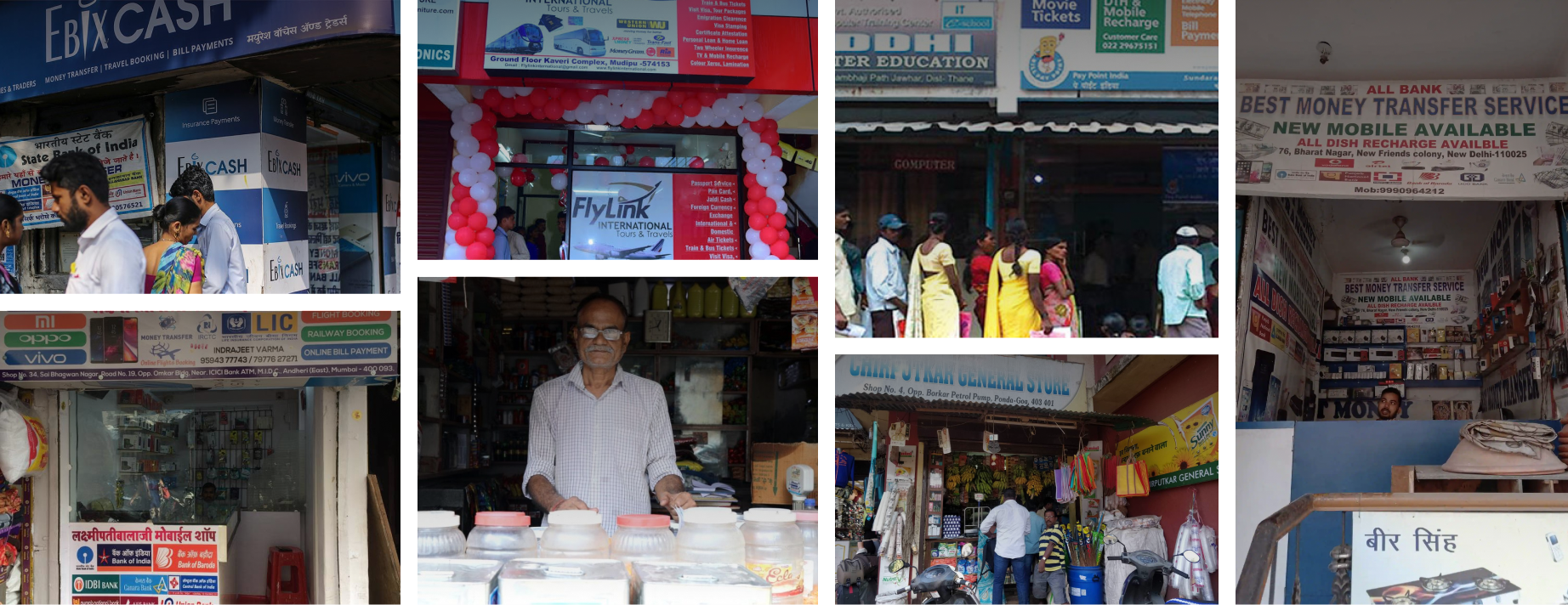
- Almost all the shops belongs to the unorganised sector of Retail industry which includes grocery stores, mobile repair shops, travel agencies, stationary store, etc.
- Retailers prefer to have a helper to help them serve customers. Some retailers asks their spouses to help them in a shop.
- Even if retailers wanted to serve each customer, they were able to address a single customer at a time. Customers usually choose to go to other shops if the waiting time is too much.
- Retailers work in cramped spaces in a bad lighting condition. Most of the shops are located across noisy roads. Only 3-4 people can stand in their shops. Shops are usually crowded in the morning and evening.
- While transacting, retailers need to spend time explaining various bank related activities to their customers.
After Ethnography, We found two major user groups -
- Entrepreneurial Persona - PayNearby as Primary business
- Trader Persona - PayNearby as Secondary business
Looking at the business goals of the next 2 quarters, together with the product manager I decided to target the Entrepreneur persona as a primary persona and Trader persona as a secondary persona.
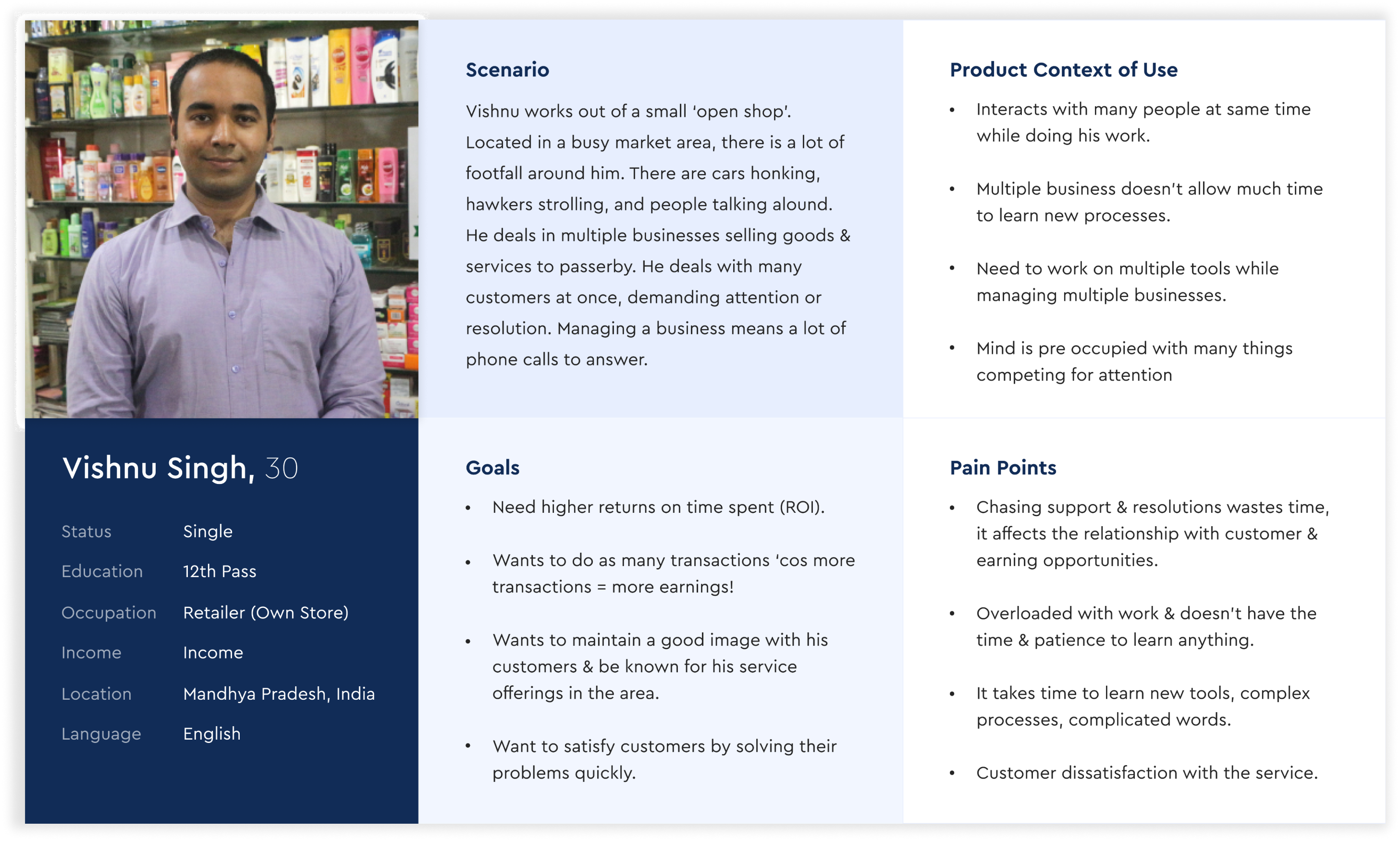
After the brief insight presentation, I shared the persona and detailed report throughout the organisation as a shared artefact. The immediate impact is as follow-
- Together with UX team, all concerned stakeholders got to learn about the target user-group and were able to build empathy for them. Many stakeholders reached out to me as they wanted to know more about target user-group.
- The activity helped UX team to showcase the importance of conducting UX Research and involving customers in the product development process.
- Product managers and UX managers could prioritise the projects for next two quarters based on insights from this research.
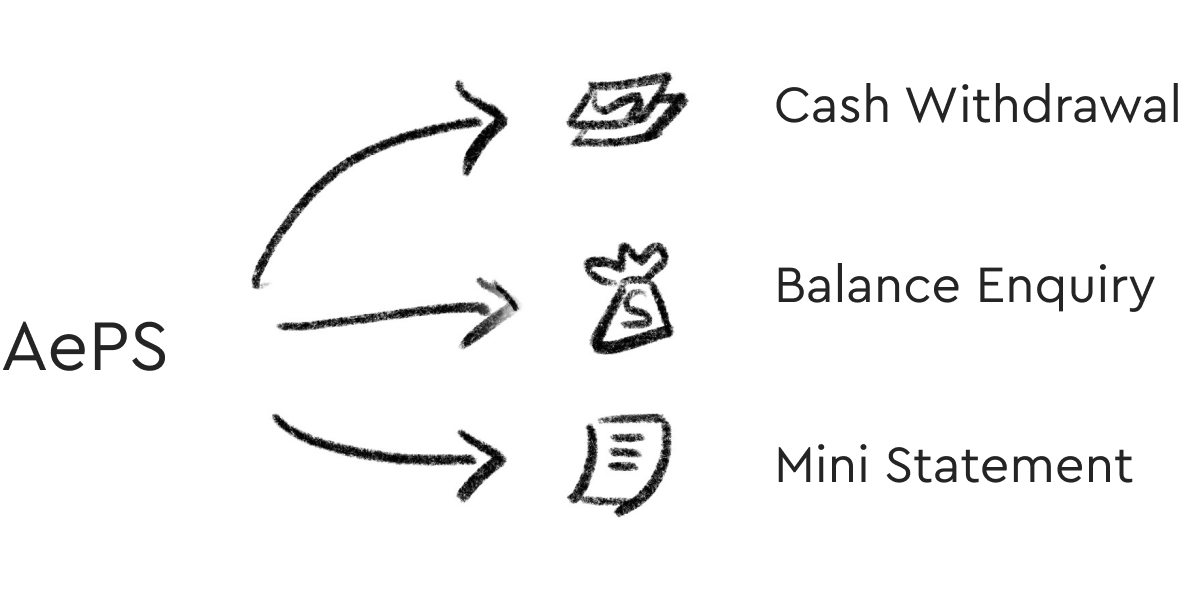
Biometric Payments is one of the major services of PayNearby Application. The service has 3 sub-services and all three services requires same input from retailer to perform the transaction. Also, back-end functionalities for these three sub-services are same.
In order to perform any Biometric Payment transaction, retailers need only 4 inputs from their customers. 4 required inputs are -
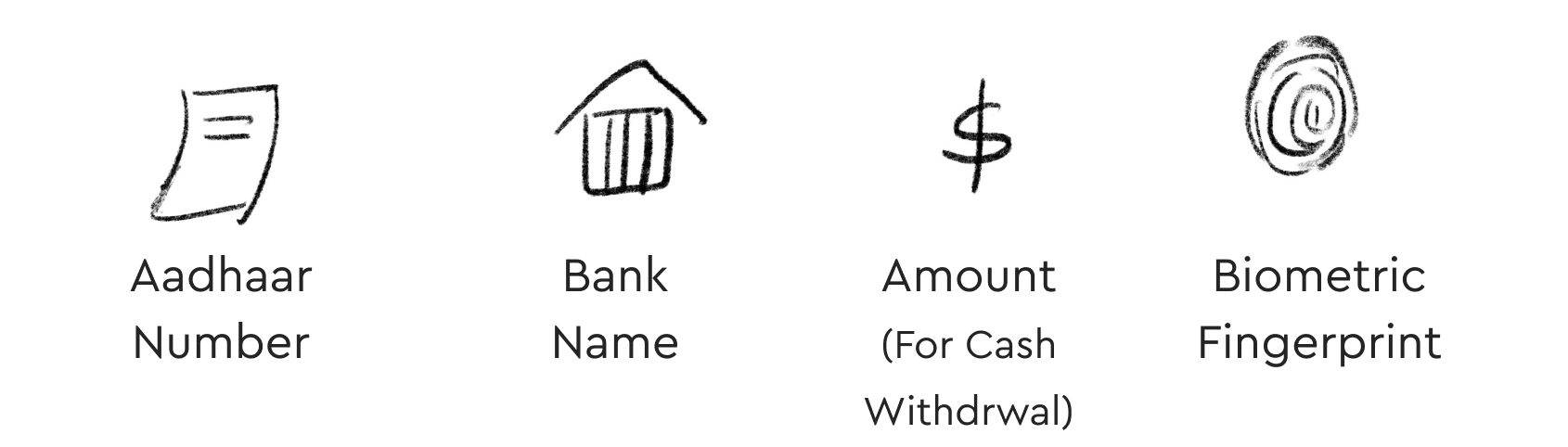
Aadhaar Number is a 12-digit random number issued by the UIDAI (“Authority”) to the residents of India. It is unique and robust enough to eliminate duplicates and fake identities. Individual’s Aadhaar number is always linked to his bank account.
Biometric Payments is one of the most revenue-generating services from the PayNearby application. Yet, the service was facing the problem of retaining existing customers to perform transactions. There are four main reasons why we decided to redesign the service-
- 40% transaction failure rate
- Increasing competition in AePS sector affecting business revenue
- Major usability concerns in current service
- 28% of daily customer care calls were about AePS service.
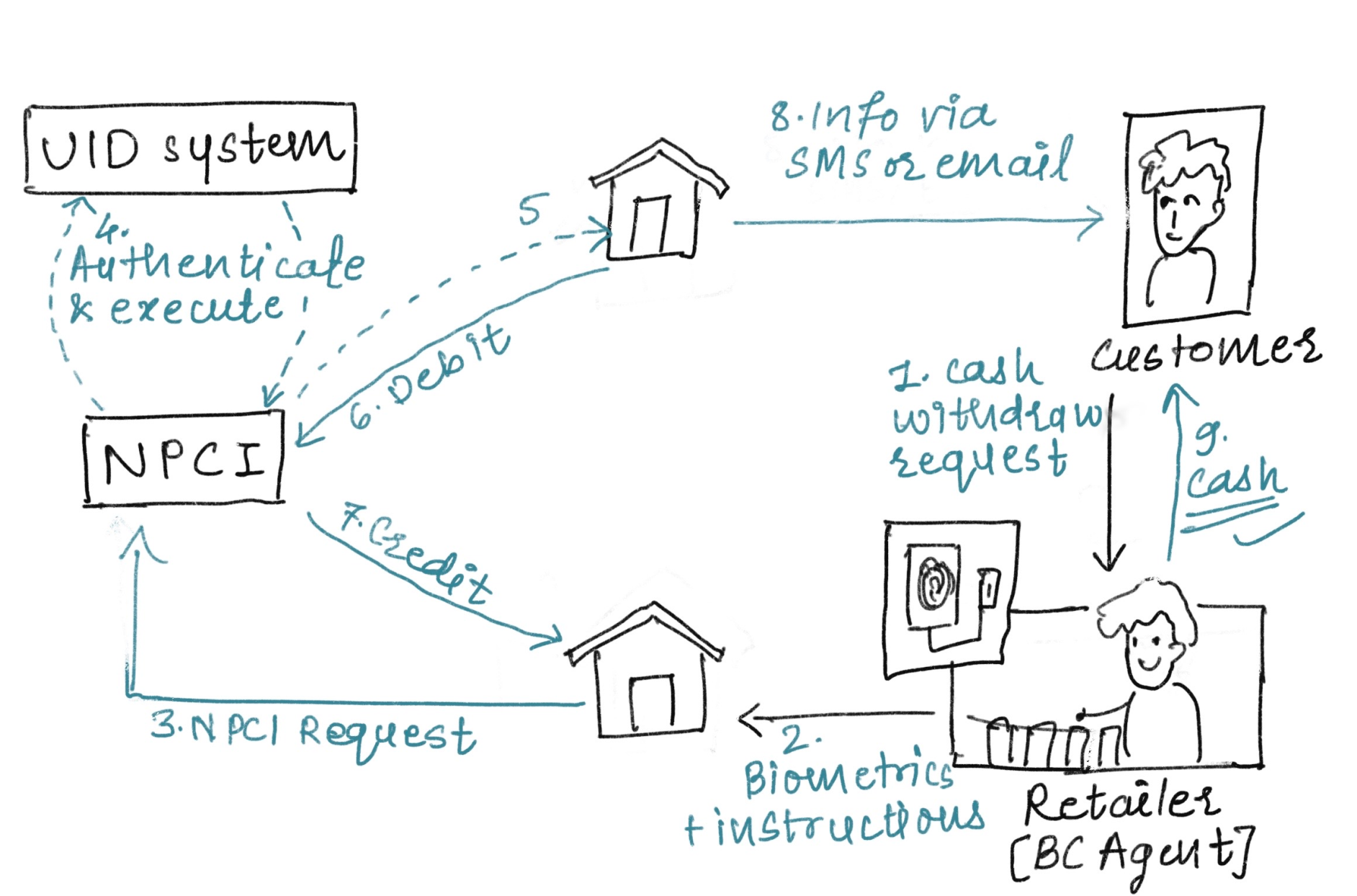
High level view of AePS functionality
I initiate this redesign project with stakeholder interviews. I interviewed 8 stakeholders from Product, Business, Technology, Marketing, Customer support and Sales departments to know their perspective on the project. Gathering data from stakeholders interviews helped us…
- To define business goals
- To define project scope and parameters
- To build a shared vision for the product
- To align both business and user goals
The overarching challenge is to redesigning Biometric Payments service to help PayNearby increase their revenue, decrease the overall bounce rate and attract more retailers by providing them a smooth and hassle free transacting experience.
High level view of AePS functionality
Severe time constraints and less budget made me do contextual inquiry. It helped me to understand users’ service specific frustrations in less time.
Together with the data science team, I recruited 8 retailers within Mumbai who fall into the entrepreneurial Persona category. I scheduled time to meet recruited retailers to know their opinion on the current service. Summarised insights are listed below-
Methodology
Why -
To understand retailer's service specific pain points and to see how retailers interact with their customers while performing AePS transactions.
Whom -
8 retailers who belong to entrepreneur persona
What -
Qualitative Research - Contextual Inquiry
Where -
In field - Local stores from Mumbai city of India
- Retailers are facing technological problems. Transaction waiting time is too much.
- Retailers felt frustrated when they were not able to answer their customers questions.
- Lack of transparency of transaction status, the product users had to bear additional support.
- Biometric device setup and registration is not intuitive. Retailers seeks external help whenever the device related problem occurs.
- Design and functionality is not consistent across web and mobile platforms. This increases transaction time as learning and mental model disturbs whenever retailer changes the device.
- Competitors design is better than PayNearby.
P1: “I have faith and trust in PayNearby's AePS service. But looking at the increasing problems in AePS, I started transacting using competitors applications. I would like to resume with PayNearby if all the problems are recovered”
P4: “It takes a lot of time to complete a single transaction. Our customers are always in a hurry and they don’t want to wait more than 4 mins max”
P5: “This company used to be the best one. But they have lots of problems with their services. Fino is not trustworthy but their process is very smooth”
High level view of AePS functionality
With contextual enquiry, I could map the pain points over the user journey and realised the opportunities at every phase of the process.
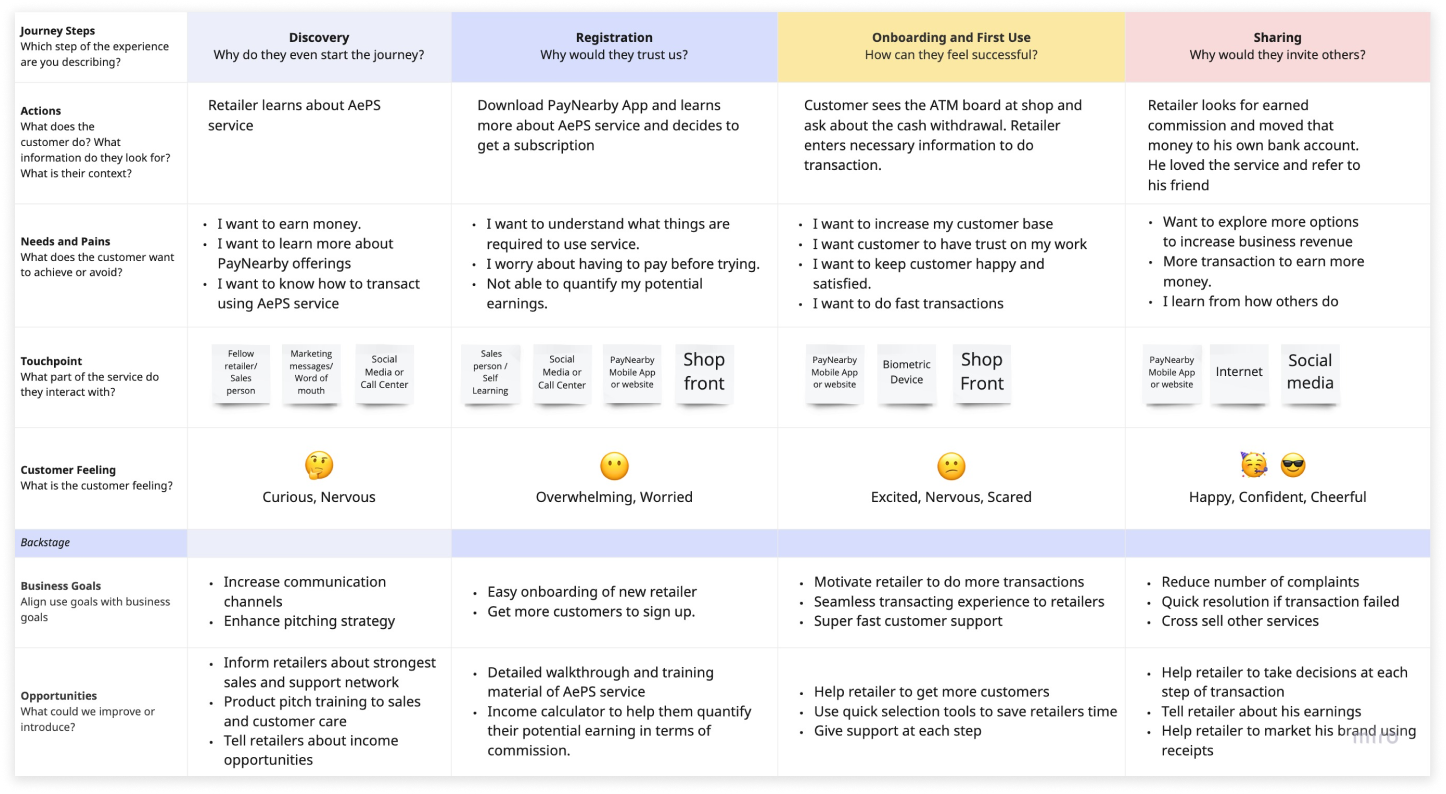
I gathered number of opportunities from the customer journey map. Considering business goals, I started prioritising these opportunities and decided to divide them in 3 phases using Impact-effort matrix-
- Phase 1 - Solve major usability concerns
How might we design a platform that is universally usable & efficient to make faster transactions? - Phase 2 - Focus on transparency and support related opportunities
How might we increase transparency to help retailers understand the current status of transactions? - Phase 3 - Make device registration flow easier for new retailers
How might we help retailers register and set up biometric devices for fingerprint authentication?
High level view of AePS functionality
- Insights from the evaluative research and the customer journey map helped team to inform the design direction of the redesign project.
- Actionable insights assisted UX/UI designers to prioritise the important user flows and deliver the designs effectively. Active engagement between team members improved the ownership and transparency at workplace.
- Overall activity helps to improve the efficiency of internal process.
Designs are approved, developed and have already started making an impact in the field.
- AePS customer care calls got reduced by 12%
- Transaction failure rate reduced upto 14%
- Time on task for cash withdrawal got reduce by 38 seconds
- Increased transparency and trust between retailer & their customer.
- Positive feedback from retailers on overall redesign of AePS
High level view of AePS functionality
- Iterations helps you get there - Throughout the project, I used the iterative process, not only for usability test but for creating research design questions as well. This helped me a lot to make design decisions better.
- Involve stakeholders early in the process - Not all stakeholders involved in this project understood user experience and its importance. Right from explaining them our vision, to taking them along the entire UX process helped me learn how to work with cross-team stakeholders.
- Balancing expectations & possibilities - We surely wanted to build the best possible user experience within the given time and with our existing resources. This helped me learn that not everything that's desired is needed. Hence, it is important to create a balance between expectations and possibilities.